A ski and snowboard watch with offline maps can help you check your position when cell service is unreliable. But “offline maps” can mean anything from a downloadable map you can pan and zoom to a basic route display.
These 10 watches span budget-friendly outdoor models and premium multisport options. The right choice depends on how you navigate, how long you stay out, and whether you can operate the watch with gloves on.
Best 10 Ski and Snowboard Watch with Offline Maps Picks for 2026
Most Versatile Bundle
KOSPET TANK M4 Special Edition

- Offline maps with dual-band GNSS
- Up to 22 hours of continuous GPS
- Includes silicone and steel bands
Best For: Rugged navigation with interchangeable straps
Rugged Value Pick

- Downloadable maps and route planning
- Dual-band GNSS with six satellite systems
- Up to 22 hours in GPS mode
Best For: Rugged, general-purpose offline navigation
Training-Focused Option

- Offline maps, compass, and barometer
- AI Coach and Readiness Score
- Up to 10 days of stated battery life
Best For: Navigation plus everyday fitness tracking
Best for Resort Maps
- Built-in maps of ski resorts worldwide
- Preloaded TopoActive maps
- Satellite and LTE features need a subscription
Best For: Built-in resort maps and premium navigation
Best for Ski-Resort Maps

- Built-in worldwide ski-resort maps
- TopoActive and downloadable maps
- Multi-band GPS with SatIQ
Best For: Resort mapping and extensive outdoor navigation
Best Lightweight Mapping Watch

- Global offline maps and planned routes
- 49 g with a bright AMOLED screen
- Up to 31 hours with dual-frequency GPS
Best For: Lightweight route navigation and training
Best for Mountain Navigation

- Downloadable maps and return-route guidance
- Dual-band GPS with altitude and weather sensors
- Up to 25 hours of GPS tracking
Best For: Offline navigation and mountain-condition awareness
Best for Long GPS Sessions

- Offline maps and L1+L5 dual-band GPS
- Up to 32 hours of continuous GPS tracking
- 170+ sports modes and local music
Best For: Long GPS outings with general fitness tracking
Best for Built-In Trail Extras

- Preloaded offline maps and dual-band GPS
- Up to 40 hours of continuous GPS
- Compass, altimeter, barometer, and flashlight
Best For: Preloaded maps and practical outdoor tools
Most Versatile Bundle – KOSPET TANK M4 Special Edition
For a ski and snowboard watch with offline maps that can also handle year-round adventures, the KOSPET TANK M4 Special Edition pairs downloadable maps with dual-band GNSS and six satellite systems. Its two included bands let you swap between silicone for activity and stainless steel for everyday wear.
Best For: Buyers who want rugged navigation and two strap options in one package.
Pros:
- Offline maps and dual-band GNSS work without cellular coverage.
- Rated for up to 15 days of heavy use or 22 hours of continuous GPS tracking.
- Stainless steel body, Gorilla 9H glass, and 20 MIL-STD-810H tests.
Cons:
- The supplied notes do not confirm dedicated ski or snowboard modes.
- No preloaded ski-resort maps are specified.
This is a flexible pick if you prioritize offline route-finding and a long claimed GPS runtime; confirm the winter-sport features you need before buying.
Rugged Value Pick – KOSPET TANK M4
The KOSPET TANK M4 is a ski and snowboard watch with offline maps worth considering if you want to download a route before heading beyond phone coverage. Dual-band GNSS, six supported satellite systems, and a bright 1.96-inch AMOLED screen strengthen its appeal for outdoor navigation.
Best For: Riders who want rugged construction and downloadable routes without prioritizing resort-specific maps.
Pros:
- Supports offline maps, route selection, and destination-point navigation.
- Claims up to 22 hours in GPS mode and 15 days with typical use.
- Stainless steel construction and 20 military-standard tests.
Cons:
- The notes do not identify dedicated skiing or snowboarding modes.
- Ski-resort maps are not specified.
Choose this model for general-purpose offline navigation and durability, while treating slope-specific tracking as an open question.
Training-Focused Option – Cubitt VIVA Pro 2
If your ideal ski and snowboard watch with offline maps also supports everyday training, the Cubitt VIVA Pro 2 combines built-in GPS and offline maps with a barometer, compass, AI Coach, and Readiness Score. Its 1.85-inch AMOLED display rounds out a feature set aimed beyond the slopes.
Best For: Buyers who want offline navigation alongside fitness and recovery features.
Pros:
- Offline maps, compass, barometer, and five-system GNSS support.
- AI Coach, Readiness Score, and more than 100 sports modes.
- Up to 10 days of stated battery life.
Cons:
- The supplied notes do not confirm ski or snowboard modes.
- No ski-resort maps or GPS-mode battery runtime are specified.
It makes the most sense as an all-around training watch with map access, rather than a confirmed resort-navigation specialist.
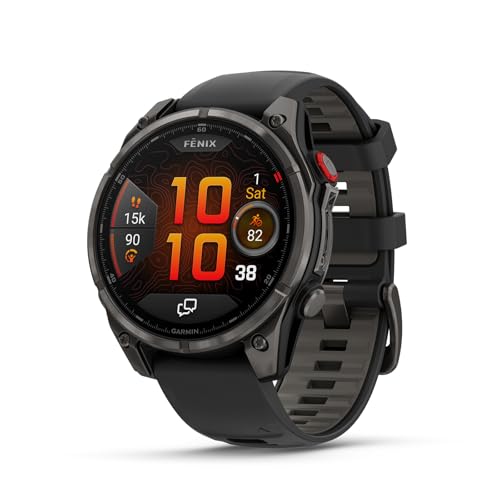
Best for Resort Maps – Garmin fēnix 8 Pro 51mm
For a ski and snowboard watch with offline maps, the Garmin fēnix 8 Pro stands out for its built-in maps of ski resorts worldwide, alongside preloaded TopoActive maps with relief shading. Its sapphire lens, titanium bezel, and 1.4-inch AMOLED display suit buyers seeking a premium multisport watch.
Best For: Riders who specifically want built-in ski-resort maps and broader outdoor navigation.
Pros:
- Built-in ski-resort maps and preloaded TopoActive maps.
- Sapphire lens, titanium bezel, and LED flashlight.
- Satellite SOS and messaging options plus LTE features with an active subscription.
Cons:
- Satellite and LTE communication require an active subscription and have coverage limitations.
- The supplied notes do not specify battery runtime.
This is the clearest resort-mapping choice of the four; consider the subscription requirements separately if off-grid communication is part of your plan.
Best for Long Battery Life – Amazfit T-Rex 3
If you want a ski and snowboard watch with offline maps for long days outdoors, the Amazfit T-Rex 3 pairs free global maps with dual-band positioning, a bright 1.5-inch AMOLED display, and Glove Mode. Its stated battery life is up to 180 hours in GPS mode, though actual use will vary.
Best For: Riders who prioritize long GPS battery life and a screen designed for bright conditions.
Pros:
- Free global maps, dual-band positioning, and turn-by-turn navigation.
- 2,000-nit peak brightness and Glove Mode.
- Rated for temperatures down to -22°F.
Cons:
- The supplied details do not confirm dedicated ski-resort maps or lift information.
- The listed sports do not establish a dedicated ski or snowboard mode.
The T-Rex 3 is a practical pick for map viewing and extended GPS tracking, but check its winter-sport features against your needs before buying.
Best for Ski-Resort Maps – Garmin tactix 8 Solar
For shoppers seeking a ski and snowboard watch with offline maps, the Garmin tactix 8 Solar stands out for its preloaded ski-resort maps and TopoActive maps. Multi-band GPS with SatIQ, a 1.4-inch solar-charged display, and button-plus-touchscreen controls round out its navigation-focused design.
Best For: Riders who want built-in resort maps alongside broader outdoor navigation tools.
Pros:
- Built-in maps for ski resorts worldwide and preloaded TopoActive maps.
- Free additional downloadable maps from around the world.
- Up to 149 hours in GPS mode with solar charging under the stated sunlight conditions.
Cons:
- Advertised solar battery figures depend on sustained exposure to strong sunlight.
- Its extensive tactical and aviation features may be unnecessary for resort use.
This is the most resort-specific mapping option here, especially if you also want a watch for demanding outdoor navigation. Treat the solar runtime figures as conditional rather than guaranteed.
Best Lightweight Mapping Watch – COROS PACE Pro
The COROS PACE Pro is a lightweight ski and snowboard watch with offline maps if you value route planning and a clear display over resort-specific features. It offers global offline maps, lets you send routes created with topographical and landscape maps in the COROS app to the watch, and provides turn-by-turn navigation.
Best For: Riders who want a lightweight watch for planned routes and year-round training.
Pros:
- Global offline maps and app-based route planning.
- 1.3-inch AMOLED display rated at up to 1,500 nits.
- Weighs 49 g and is rated for up to 31 hours with dual-frequency GPS.
Cons:
- The supplied notes do not mention built-in ski-resort maps.
- Always-On display mode reduces stated battery life from 20 days to six days.
The PACE Pro makes sense when you plan routes in advance and want a lighter watch that also supports training. Look elsewhere if preloaded resort maps are your priority.
Best for Mountain Navigation – Mibro GS Explorer S Titanium
If you want a ski and snowboard watch with offline maps that can also guide year-round outdoor trips, the Mibro GS Explorer S pairs downloadable global maps with dual-band GPS, route following, waypoints, and a return-route feature. Its altitude, barometer, compass, and weather-trend readings add useful context on the mountain.
Best For: Riders who want offline route tools and outdoor sensors in a lightweight titanium watch.
Pros:
- Downloadable maps, waypoints, route following, and navigation back without a signal.
- Up to 25 hours of GPS tracking and 20 days of daily use.
- 1.32-inch AMOLED display, 10ATM water resistance, and a skiing sport mode.
Cons:
- Maps must be downloaded before heading out of signal range.
- The supplied details do not establish dedicated ski-run or resort-map features.
The Mibro is the strongest fit here if navigation and environmental awareness matter more than smartwatch extras. Check that its map coverage suits your destination before relying on it for a trip.
Best for Long GPS Sessions – ANYMOVING M1 PRO
POPUX ANYMOVING M1 PRO Smart Watch for Men, 1.5" AMOLED Dual Band GPS Smart Watch with Offline Maps
Check Price On AmazonThe ANYMOVING M1 PRO is a ski and snowboard watch with offline maps to consider if you also want long GPS runtime and everyday fitness features. It combines L1+L5 dual-band GPS, support for five satellite systems, a 1.5-inch AMOLED display, and local music playback.
Best For: Outdoor users who prioritize GPS battery life and a broad range of training tools.
Pros:
- Offline maps and dual-band GPS support navigation away from cell service.
- Rated for up to 32 hours of continuous GPS tracking or 15 days of typical use.
- Offers 170+ sports modes, training metrics, and onboard music playback.
Cons:
- The supplied notes do not confirm a dedicated skiing or snowboarding mode.
- Its 5ATM/IP68 rating should not be taken as a guarantee against every winter-use condition.
Choose this model for extended GPS tracking and versatile fitness use, but verify its available winter-sport modes and mapping options if those are central to your purchase.
Best for Built-In Trail Extras – Anywise W1 Pro
For shoppers comparing a ski and snowboard watch with offline maps, the Anywise W1 Pro stands out for its preloaded maps and built-in outdoor tools. Alongside L1+L5 dual-band GPS, it provides a compass, altimeter, barometer, and adjustable LED flashlight.
Best For: Riders and hikers who want preloaded navigation plus a flashlight and orientation tools.
Pros:
- Preloaded offline maps and support for six satellite systems.
- Up to 40 hours of continuous GPS positioning or 12 days of daily use.
- Compass, altimeter, barometer, and four-level LED flashlight add practical outdoor utility.
Cons:
- The supplied notes do not confirm dedicated ski or snowboard tracking or resort maps.
- Message notifications cannot be answered from the watch.
The W1 Pro makes sense if you value a ready-to-use offline map and handy outdoor hardware. Confirm the map detail you need for your riding area before treating it as a substitute for a dedicated mountain navigation device.
How We Picked the Best Ski and Snowboard Watch with Offline Maps
We focused on watches positioned for outdoor GPS use, prioritizing stated offline-map or navigation capabilities alongside battery life, cold-weather usability, durability, and price range. A product listing alone cannot confirm how detailed its maps are or how well it performs on snow. Check the current specifications and supported map regions before buying.
Quick Comparison: Where to Start
Start with the feature you cannot compromise on. Garmin fēnix 8 Pro and tactix 8 Solar are premium options for buyers considering extensive outdoor navigation and training features; compare their specific map packages, size, and battery specifications. The Amazfit T-Rex 3, Mibro GS Explorer S Titanium, and KOSPET Tank M4 models are worth comparing if you want an outdoor-oriented watch at a different price point. The Cubitt VIVA Pro 2, ANYMOVING M1 PRO, and Anywise W1 Pro advertise offline maps; verify what you can download and view without a phone. If the lightweight COROS PACE Pro appeals to you, confirm that its map and navigation tools cover your intended terrain.
Key Buying Factors for a Ski and Snowboard Watch with Offline Maps
Map Detail and Setup
Look beyond the phrase “offline maps.” Can the watch show trails, lifts, roads, and terrain, or only a saved route? Are your destination areas included, and can you download them before leaving Wi-Fi? Check storage, map update procedures, and whether navigation works without a cellular connection or nearby phone. Resort maps and backcountry topographic maps serve different purposes.
GPS and Battery Life
Compare battery estimates in GPS-plus-map use, not just smartwatch mode. Continuous tracking, bright screens, dual-band GPS, and cold temperatures can shorten runtime. Dual-band GPS may help where cliffs or dense trees interfere with reception, but it does not replace a clear view of the sky. For long days or multiday trips, leave a generous battery margin.
Controls and Mountain Readiness
Physical buttons can be easier than a touchscreen with gloves or wet hands. Check display legibility in glare, wrist fit over or under jacket cuffs, and water-resistance specifications. A rugged rating is useful, but it does not guarantee that a watch will shrug off every impact or operate at its rated battery life in freezing weather.
Who Should Buy Which Ski and Snowboard Watch with Offline Maps?
Resort skiers and riders: Prioritize a readable screen, straightforward maps for your destination, and enough battery for a full day. Backcountry travelers: Favor dependable topographic mapping, route tools, accessible buttons, and substantial battery reserve; carry a separate navigation method and appropriate avalanche safety equipment. Training-focused buyers: Compare activity metrics and comfort as carefully as map functions. Value shoppers: Consider lower-priced watches that advertise offline maps, but verify the actual map coverage and phone-free features before choosing one over a premium model.