Cold hands can make winter work, commuting, and outdoor recreation uncomfortable, but bulky insulated gloves are not always practical. Lightweight heated gloves add targeted warmth while preserving the dexterity needed for phones, tools, handlebars, and everyday tasks.
This roundup compares rechargeable heated liners, touchscreen gloves, waterproof designs, and fingerless options so you can choose the right balance of warmth, battery life, fit, and flexibility for your routine.
Best 10 Lightweight Heated Gloves Picks for 2026
Quick-Heat Outdoor Pick

- 10-second heat-up with three settings
- Waterproof shell and touchscreen fingertips
- Up to 8 hours of runtime on low
Best For: Winter commuting and outdoor activities
Layer-Friendly Choice

- Slim Lycra and fleece liner design
- Three heat settings with up to 6 hours of runtime
- Touchscreen thumb and forefinger sensors
Best For: Layering under outer gloves
Feature-Rich Performance Pick

- Full finger-back heating in about 30 seconds
- Up to 7 hours on low with 3000mAh batteries
- Water-resistant, touchscreen, and anti-slip design
Best For: Driving, riding, and winter chores
Adjustable-Warmth Liner

- Five heat modes from 113°F to 158°F
- Full-hand and fingertip heating
- Slim touchscreen design for flexible movement
Best For: Precise warmth under an outer glove
Best Overall Lightweight Heated Gloves
Thin Rechargeable Heated Liners

- Up to 7 hours of warmth
- Three heat settings and touchscreen fingertips
- Wind-resistant, water-resistant, slim design
Best For: Versatile winter activities and layering under outer gloves
Best Heated Glove Liners for Layering

- Three heat levels with 2–9 hours of runtime
- Battery display and dual-battery USB charging
- Stretch fit available in sizes XXS–XXL
Best For: Commuting, everyday wear, and layering under outer gloves
Best Overall
Thin Heated Gloves with Long Battery Life

- 7.4V 3000mAh batteries provide up to 6.5 hours of heat.
- Expanded carbon-fiber heating covers more of the hand.
- Touchscreen fingertips and silicone palms improve daily usability.
Best For: Versatile outdoor activities and everyday cold-weather wear
Best Lightweight Liner

- Lycra and fleece construction offers a thin, flexible fit.
- Up to 6–8 hours of warmth from rechargeable batteries.
- Three heat levels, battery display, and touchscreen fingertips.
Best For: Layering, typing, driving, cycling, and light outdoor use
Best for Adjustable Heat
Water-Resistant Heated Glove Liners
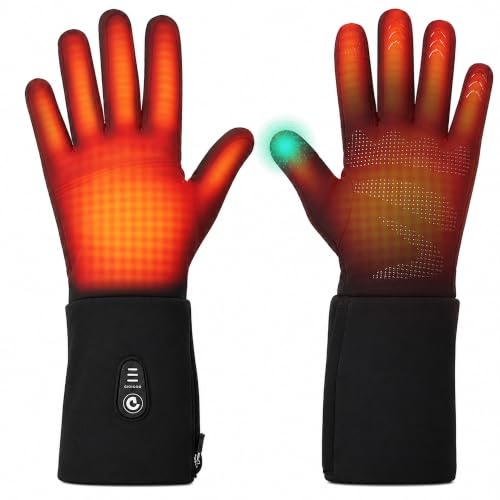
- Five heat settings support precise warmth control.
- Carbon-fiber elements heat fingers and hand backs quickly.
- Water-resistant shell helps protect against snow and light rain.
Best For: Active winter sports and outdoor work in changing conditions
Quick-Heat Outdoor Pick – Full-Coverage Heated Gloves
For shoppers seeking lightweight heated gloves with broad outdoor versatility, this rechargeable pair combines 10-second heating with coverage across the fingers and back of the hand. Waterproof and windproof construction, touchscreen fingertips, and a silicone grip suit winter commuting and activities such as skiing, hiking, and cycling.
Best For: Commuters and outdoor users who want fast warmth, weather protection, and up to 8 hours of low-setting runtime.
Pros:
- Heats in about 10 seconds and offers three temperature settings.
- Heating elements cover the fingers and back of the hand.
- Includes two rechargeable 3000mAh batteries and a storage pouch.
- Touchscreen fingertips, adjustable cuffs, and a non-slip palm support everyday use.
Cons:
- The supplied size is Large, so fit should be checked carefully.
- The product is described as waterproof and windproof, but no specific waterproof rating is provided.
This is a practical all-around option when quick heat, grip, and weather-resistant features matter more than an ultra-thin liner profile.
Layer-Friendly Choice – Thin Heated Glove Liners
These lightweight heated gloves are designed as thin liners rather than bulky standalone winter gloves. A soft Lycra exterior, breathable fleece interior, three heat settings, and touchscreen sensors make them suitable for adding warmth under another pair of gloves during outdoor work or recreation.
Best For: People who want a low-bulk heated layer for skiing, cycling, hiking, or cold-weather work.
Pros:
- Thin construction is intended to fit beneath other gloves without feeling clunky.
- Far-infrared heating elements cover the back of the hand and fingers.
- Rechargeable 2200mAh batteries provide up to 6 hours of operation when fully charged.
- Touch sensors on the thumb and forefinger allow phone use without removing the liners.
Cons:
- As liners, they may need an outer glove for greater protection in severe weather.
- The listed warranty is 90 days.
- Extra batteries are suggested for extended use but are sold separately.
Choose this pair when layering flexibility and dexterity are priorities. Its liner design is more convenient beneath outer gloves than a heavily insulated heated glove.
Feature-Rich Performance Pick – JS LifeStyle Heated Gloves
For lightweight heated gloves that balance warmth with flexibility, this JS LifeStyle pair uses a stretchy Lycra shell and a four-layer construction. Full finger-back heating, touchscreen fingertips, water-resistant protection, and a grip palm make it a strong fit for driving, shoveling, riding, and other winter tasks.
Best For: Users who want flexible heated gloves with detailed battery information, reliable grip, and a selectable runtime of up to 7 hours.
Pros:
- Heats the entire back of the hand and every finger in about 30 seconds.
- Three heat levels offer up to 7 hours on low, with 3000mAh batteries and a four-hour charge time.
- Touchscreen fingertips and an anti-slip palm support driving and device use.
- Water-resistant layered construction and lights that can be turned off add practical details.
Cons:
- The supplied size is Medium, so shoppers should confirm the fit.
- The gloves are described as water-resistant or splash-proof rather than fully waterproof.
- High heat reduces the stated runtime to about 3.5 hours.
This is an appealing choice for buyers who value comfort, dexterity, safety-tested batteries, and more precise runtime information in a lightweight heated glove.
Adjustable-Warmth Liner – Ultra-Thin Heated Work Gloves
These lightweight heated gloves are built for users who prefer an ultra-thin liner with flexible hand movement. Full-hand heating, five temperature modes from 113°F to 158°F, battery indicators, and touchscreen fingers provide fine control for indoor and outdoor winter activities.
Best For: Users who want precise heat adjustment and plan to wear an outer glove in especially cold conditions.
Pros:
- Five heat settings provide more adjustment than a typical three-setting design.
- Heating covers the back of the hand and fingertips.
- Ultra-thin construction supports movement and touchscreen use.
- Includes two rechargeable lithium-polymer batteries, a charger, pouch, and manual.
Cons:
- The product recommends wearing an additional outer glove in extreme cold.
- The listed size is X-Small-Small, limiting fit for larger hands.
- The notes do not specify a runtime or battery capacity.
This liner makes the most sense for buyers who prioritize a slim profile and precise temperature control over maximum standalone weather protection or documented runtime.
Best Overall Lightweight Heated Gloves – Thin Rechargeable Heated Liners
These lightweight heated gloves are designed as versatile liners, combining a slim fit with rechargeable warmth for cold-weather work, driving, skiing, cycling, and everyday use. Three heat settings, touchscreen fingertips, and a water-resistant, wind-resistant outer layer make them a practical all-around option.
Best For: Shoppers who want slim heated liners with extended battery life and broad outdoor versatility.
Pros:
- Up to 7 hours of warmth per charge, depending on settings and conditions.
- Three heat levels with far-infrared heating elements for even warmth.
- Touchscreen-compatible thumb and index fingers plus an anti-slip palm.
- Wind-resistant, water-resistant, quick-drying construction.
Cons:
- They are thinner than standard outdoor gloves and may need an outer glove in extreme cold.
- Extra batteries are available separately for longer heating time.
Choose this pair if you want a lightweight heated glove liner that balances warmth, dexterity, weather resistance, and long runtime. Its slim design is particularly useful when layering under larger winter gloves.
Best Fingerless Lightweight Heated Gloves – Cordless Heated Work Gloves
For tasks that require maximum finger flexibility, these lightweight heated gloves use a fingerless design and cordless rechargeable battery. They weigh about 180 grams and provide two heat settings for typing, touchscreens, driving, photography, hunting, and other activities where precise handling matters.
Best For: Users who prioritize open fingertips, low weight, and hand flexibility over full-finger coverage.
Pros:
- Fingerless design supports typing, touchscreens, shooting, and detailed work.
- Lightweight construction weighs approximately 180 grams.
- 3.7V 3000mAh batteries provide up to 3 hours of warmth.
- Stretch fabric, non-slip palm padding, pull-tabs, and adjustable Velcro closure improve usability.
Cons:
- Open fingertips provide less coverage than full-finger heated gloves.
- Only two heat settings are available.
- One-size-fits-most construction may offer less precise sizing.
This is a practical choice when dexterity is more important than maximum coverage. The fingerless format and cordless battery make it convenient for indoor work and outdoor tasks that involve frequent handling.
Best Heated Glove Liners for Layering – SAVIOR HEAT S13 Heated Liners
The SAVIOR HEAT S13 is a flexible option for shoppers seeking lightweight heated gloves that fit beneath outer winter gloves. Its stretch fabric, velvet lining, touchscreen fingertips, and three heat levels support everyday activities such as commuting, driving, typing, walking, and layering for skiing or snowboarding.
Best For: Daily use and layering beneath windproof or waterproof outer gloves.
Pros:
- Carbon-fiber heating elements warm the back of the hand, fingers, and fingertips.
- Three heat levels with approximately 2–9 hours of runtime depending on the setting.
- Battery display shows remaining power, and both batteries charge together via USB.
- Available in sizes XXS–XXL with touchscreen-compatible fingertips.
Cons:
- The liners are not windproof or waterproof.
- High-heat runtime is approximately 2–3 hours.
- They work best under protective outer gloves in demanding winter conditions.
The S13 stands out as a comfortable heated layer rather than a standalone weatherproof glove. Its broad size range, battery display, and long low-setting runtime make it well suited to everyday winter wear and layered outdoor use.
Best Overall – Thin Heated Gloves with Long Battery Life
These lightweight heated gloves combine expanded carbon-fiber heating coverage with a 7.4V 3000mAh rechargeable battery. They are a practical choice for shoppers who want thin heated gloves with adjustable warmth, touchscreen fingertips, and enough insulation for everyday cold-weather activities.
Best For: Hiking, cycling, golf, fishing, skiing, and general outdoor use where warmth and hand mobility matter.
Pros:
- Up to 6.5 hours of continuous heat with three temperature levels.
- Enlarged heating area surrounds more of the hand for comprehensive warmth.
- Touchscreen thumb and index fingertips support phone and tablet use.
- Water-resistant outer fabric, 3M thermal cotton insulation, and silicone palms add everyday practicality.
Cons:
- Only a medium size is listed in the supplied details.
- The included charger and battery setup may require planning before extended outings.
This is the strongest all-around option in the group for buyers prioritizing battery capacity, broad heating coverage, and versatile outdoor use in a relatively streamlined glove.
Best Lightweight Liner – Flexible Heated Glove Liners
Designed with Lycra and fleece, these lightweight heated gloves have a flexible second-skin feel for typing, driving, cycling, or layering beneath larger winter gloves. Their rechargeable batteries provide up to 6–8 hours of warmth, while the touchscreen fingertips preserve everyday convenience.
Best For: Users who want thin heated gloves for dexterity, indoor-to-outdoor transitions, or layering under ski gloves.
Pros:
- Lightweight, breathable construction is designed for a close and flexible fit.
- Low-temperature-resistant batteries provide up to 6–8 hours of warmth.
- Three heat settings and a four-level battery indicator simplify operation.
- Composite-fiber heating warms the back of the hand and fingertips quickly.
Cons:
- The supplied notes recommend extra winter gloves for maximum warmth outdoors.
- Battery charging is listed at approximately seven hours.
- Extra batteries are sold separately for extended use.
Choose this pair when flexibility and layering are more important than heavy insulation. It is the clearest fit for shoppers seeking a lightweight liner that can also function as a standalone glove in milder cold.
Best for Adjustable Heat – Water-Resistant Heated Glove Liners
These lightweight heated gloves stand out for five adjustable heat levels and carbon-fiber elements that warm the fingers and back of the hands quickly. The water-resistant shell, insulated lining, and touchscreen fingertips make them suited to varied winter activities without giving up basic everyday convenience.
Best For: Skiing, snowboarding, riding, hunting, camping, hiking, and outdoor work in changing winter conditions.
Pros:
- Five heat settings allow more precise temperature adjustment than simpler designs.
- Rechargeable 7.4V 2200mAh batteries provide up to six hours depending on heat level.
- Water-resistant outer material helps block snow, light rain, and cold wind.
- Conductive thumb and index fingertips support touchscreen use.
Cons:
- Battery runtime varies with the selected heat setting.
- The supplied details list a medium-large size, which may limit fit options.
- No charger is listed among the included components.
This option makes the most sense for buyers who value fine-grained heat control and weather resistance. Its feature set is particularly useful when outdoor conditions and activity levels change throughout the day.
How We Picked These Lightweight Heated Gloves
We focused on rechargeable heated gloves and liners designed to provide warmth without excessive bulk. The selection includes thin liner-style models, waterproof ski gloves, touchscreen-compatible options, fingerless designs, and gloves with different battery capacities. We also considered practical details such as intended activity, dexterity, charging convenience, advertised heating coverage, and whether the design can be worn alone or under a larger outer glove.
Because warmth and runtime can vary with temperature, hand movement, glove fit, and heat setting, treat manufacturer specifications as estimates rather than guarantees. A close fit and properly charged batteries are especially important for heated liners.
Quick Comparison
- Best for maximum weather protection: Choose a waterproof heated ski-glove design.
- Best for layering: Select a thin heated liner that fits beneath an insulated shell.
- Best for typing and phone use: Prioritize touchscreen fingertips and a flexible, low-profile fit.
- Best for work dexterity: Consider thin liners or fingerless heated gloves, depending on how much finger coverage you need.
- Best for longer cold sessions: Look for higher-capacity batteries, multiple heat settings, and the option to carry a spare set.
Key Buying Factors for Lightweight Heated Gloves
Fit and Flexibility
Heated gloves should fit close to the hand so warmth transfers efficiently, but they must not restrict circulation. Check the sizing chart and measure your hand according to the manufacturer’s instructions. Extra room can reduce dexterity and make liners bunch beneath outer gloves.
Battery Capacity and Runtime
Battery ratings such as 3.7V or 7.4V and capacity figures in milliamp-hours do not guarantee a specific runtime. Compare the stated runtime at each heat level, charging time, battery placement, and whether batteries are included. Higher heat settings generally consume power faster.
Heating Coverage and Controls
Look for heating zones that match your needs, such as the backs of the hands and fingers. Simple, accessible controls are useful when wearing an outer glove. Multiple settings let you conserve battery indoors or increase warmth during stationary periods.
Weather Resistance and Layering
Thin liners are convenient for cycling, typing, hiking, and work, but they may need a waterproof outer shell in rain or snow. If you plan to ski or work outdoors, check the product’s water-resistance claims, cuff design, insulation, and durability rather than relying on the word “waterproof” alone.
Touchscreen Performance and Care
Touchscreen fingertips are helpful, but responsiveness depends on fit and the specific device. Follow care instructions carefully: batteries usually need to be removed before washing, and heated components should not be treated like ordinary machine-washable gloves.
Who Should Buy Which Lightweight Heated Gloves?
Commuters and typists should favor thin, flexible liners with touchscreen fingertips and modest warmth. Skiers and winter hikers will generally benefit from a heated glove with stronger weather protection or a liner paired with a waterproof shell. Outdoor workers should prioritize secure cuffs, durable construction, dependable controls, and batteries that can last through the work period. Cyclists need a close fit, flexible fingers, and enough room to maintain grip on handlebars. People with especially cold hands may prefer broader heating coverage and a higher-capacity battery, while occasional users can save space and weight with a simple rechargeable liner.