A pace alert can tell you when you drift outside your target range without making you stare at your wrist. The right watch makes those cues easy to set, easy to notice, and useful during the runs you actually do.
These 10 picks span basic GPS watches, lightweight training models, and feature-rich options. Before choosing, check how each watch handles pace targets and alerts—not just whether its product listing mentions pace.
Best 10 Running Watch with Pace Alerts Picks for 2026
Simple GPS Timer

- GPS pace alarm
- Up to 50 saved laps
- Last 10 workouts stored
Best For: Basic pace reminders and lap tracking
Compact Training Coach

- Adaptive Garmin Coach plans
- Training readiness insights
- Up to 18 hours in GPS mode
Best For: Guided training on smaller wrists
Lightweight Route Runner

- 30g with nylon band
- Up to 38 hours of GPS
- Dual-frequency GPS and routes
Best For: Lightweight long runs and route guidance
Advanced Mapping Pick

- Full-color maps and multi-band GPS
- Advanced running metrics
- Up to 26 hours in GPS mode
Best For: Mapped runs and detailed training analysis
Lightweight Training Pick

- 32 g with nylon band
- Up to 41 hours of GPS use
- AMOLED display with mixed controls
Best For: Runners prioritizing low weight and battery life
Guided Training Pick

- GPS pace and distance tracking
- Adaptive workout suggestions
- Up to 19 hours in GPS mode
Best For: Runners seeking guided workouts and recovery insights
Long-Run Metrics Pick
- Tracks pace, distance, and laps
- 41 g lightweight design
- Up to 35 hours in training mode
Best For: Runners focused on core metrics and longer sessions
Everyday Training Pick

- PacePro GPS-based pace guidance
- Cadence alerts and suggested workouts
- Up to 20 hours in GPS mode
Best For: Straightforward pace guidance and daily training suggestions
Mapping and Training Pick

- Full-color maps and turn-by-turn courses
- Multi-band GNSS with SatIQ
- Up to 31 hours in GPS mode
Best For: Mapping and detailed multisport training feedback
Race-Planning Pick

- PacePro and Finish Time features
- Free 5K to half-marathon plans
- 17 built-in activity profiles
Best For: Pace guidance and race-training tools
Simple GPS Timer – EZON T031 Running Watch
If you’re shopping for a running watch with pace alerts, the EZON T031 is a basic GPS option with a pace alarm and straightforward run tracking. It records distance, average pace, calories, and elapsed time without requiring a feature-heavy training dashboard.
Best For: Runners who want a simple pace alarm and lap-by-lap workout records.
Pros:
- Includes a pace alarm alongside GPS speed and distance tracking.
- Saves up to 50 laps with pace, distance, duration, and average speed data.
- Stores the last 10 exercise records for on-watch review.
Cons:
- Listed battery life averages 6 hours.
- No training plans or heart-rate tracking are specified.
The T031 makes the most sense if pace reminders and basic post-run numbers matter more to you than advanced coaching. Check whether its stated battery life covers your longest outings.
Compact Training Coach – Garmin Forerunner 570 42mm
For runners comparing a running watch with pace alerts, the 42mm Forerunner 570 is worth considering for its adaptive training tools and smaller-wrist fit. The supplied specifications do not confirm a dedicated pace-alert setting, so verify that feature before buying specifically for it.
Best For: Runners with smaller wrists who want guided training and recovery insights.
Pros:
- Garmin Coach plans and daily suggested workouts adapt to performance and recovery.
- Training readiness and training status provide context for harder sessions.
- Bright AMOLED touchscreen has button controls; GPS battery life is rated up to 18 hours.
Cons:
- Dedicated pace alerts are not confirmed in the supplied specifications.
- Wrist-based calling requires pairing with a smartphone.
This model is a strong fit when you want coaching alongside run tracking, not just a pace display. Its recovery metrics are estimates, and pace-alert support should be checked separately.
Lightweight Route Runner – COROS PACE 3 Chalk Nylon
If you’re looking for a running watch with pace alerts for long runs, the COROS PACE 3 stands out for its light 30g nylon-band design, dual-frequency GPS, and long claimed GPS runtime. The supplied notes do not specify pace-alert functionality, so confirm that setting if it is essential to your workouts.
Best For: Runners who prioritize low weight, GPS endurance, and breadcrumb route guidance.
Pros:
- Claimed battery life reaches 38 hours of continuous GPS tracking.
- Dual-frequency satellite tracking is designed for more reliable positioning around tall buildings.
- App-planned routes sync to the watch for breadcrumb navigation.
Cons:
- Pace alerts are not confirmed in the supplied notes.
- Navigation is described as breadcrumb guidance rather than full-color maps.
The PACE 3 is particularly appealing for extended training and unfamiliar routes. Confirm its alert options before choosing it solely to enforce a target pace.
Advanced Mapping Pick – Garmin Forerunner 970 47mm
Runners seeking a running watch with pace alerts may also be drawn to the Forerunner 970’s detailed training tools and on-watch navigation. Its supplied specifications do not explicitly confirm pace alerts, but they do describe multi-band GPS, full-color maps, and adaptive coaching.
Best For: Dedicated runners who want mapped routes and detailed training analysis.
Pros:
- Full-color maps, multi-band GPS, and dynamic round-trip routing support route exploration.
- Running tolerance, wrist-based dynamics, and running power add training detail.
- Rated for up to 26 hours in GPS mode and includes an LED flashlight.
Cons:
- Dedicated pace-alert functionality is not confirmed in the supplied notes.
- Running economy and step speed loss require a separately sold HRM 600 monitor.
Choose this model for its mapping and deeper run analysis rather than assuming every advanced metric works out of the box. Verify pace-alert controls if timed pace boundaries are central to your training.
Lightweight Training Pick – COROS PACE 4
If you’re shopping for a running watch with pace alerts, the COROS PACE 4 is worth considering for its light design and long GPS battery life. The supplied details do not confirm pace-alert settings, so check that feature before buying.
Best For: Runners who prioritize low weight, a bright display, and fewer charging breaks.
Pros:
- Weighs 32 g with the nylon band and measures 11.8 mm thin.
- 1.2-inch AMOLED touchscreen with auto-adjusting brightness.
- Rated for up to 41 hours of continuous GPS use and 19 days of daily use.
- Digital crown, buttons, and touchscreen offer multiple ways to control it.
Cons:
- Pace-alert functionality is not specified in the supplied notes.
- The stated 32 g weight is for the nylon band, not this silicone-band configuration.
The PACE 4 makes a strong case for comfortable, long-duration training, but confirm its alert options if pace notifications are your deciding feature.
The Garmin Forerunner 165 uses built-in GPS to track pace and distance, making it a practical option to investigate if you want a running watch with pace alerts. Pace-alert settings are not confirmed in the supplied notes.
Best For: Runners who want guided workouts and recovery insights alongside everyday smartwatch features.
Pros:
- Daily suggested workouts adapt to performance and recovery.
- Garmin Coach and race-adaptive plans support event-focused training.
- AMOLED touchscreen pairs with physical button controls.
- Rated for up to 11 days in smartwatch mode or 19 hours in GPS mode.
Cons:
- Supplied notes do not specify pace-alert functionality.
- Safety messaging requires a paired compatible phone with network coverage and setup.
Choose this model if structured training matters as much as on-run pace data; verify its alert controls before relying on it for pace cues.
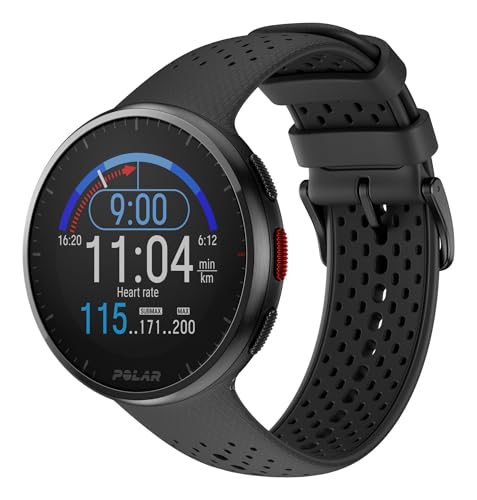
The POLAR Pacer Pro tracks pace, distance, time, and laps, so it belongs on the shortlist when comparing a running watch with pace alerts. The supplied notes do not establish whether it can issue pace alerts.
Best For: Runners who want lightweight pace tracking, recovery tools, and extended training battery life.
Pros:
- 41 g design keeps the watch relatively light for training.
- Tracks pace, distance, laps, and time on a color display.
- Rated for up to 35 hours in training mode or 100 hours in power-save mode.
- Optical heart-rate tracking and sleep and recovery tools add training context.
Cons:
- Pace-alert capability is not specified in the supplied notes.
- Uses button controls rather than a listed touchscreen.
The Pacer Pro emphasizes core running metrics and training endurance. If audible or vibration pace prompts are essential, confirm their availability before purchasing.
Everyday Training Pick – Garmin Forerunner 55 (White)
If you want a running watch with pace alerts, the white Forerunner 55 is worth a look for its cadence alerts and PacePro GPS-based pace guidance. It also tracks distance and speed with built-in GPS and suggests workouts based on your training history, fitness level, and recovery time.
Best For: Runners who want straightforward pace guidance and daily training suggestions.
Pros:
- PacePro offers pace guidance for a selected course or distance.
- Daily suggested workouts help structure training.
- Battery life is rated up to two weeks in smartwatch mode or 20 hours in GPS mode.
Cons:
- PacePro is not compatible with on-device courses.
- Its 1.04-inch display may feel small if you prefer more screen space.
This is a practical choice if pacing and a simple training routine matter more to you than a large display. Keep the PacePro course limitation in mind when planning race-day use.
The Forerunner 965 is a feature-rich option to consider when shopping for a running watch with pace alerts, particularly if route navigation and training context are priorities. Its notes emphasize full-color maps, turn-by-turn courses, multi-band GPS, and race-adaptive suggested workouts rather than specifying a dedicated pace-alert function.
Best For: Runners and multisport athletes who want mapping and detailed training feedback.
Pros:
- Built-in full-color maps and turn-by-turn courses support route navigation.
- Multi-band GNSS with SatIQ is designed for accuracy in challenging environments while optimizing battery life.
- Training readiness, wrist-based running dynamics, and running power add workout context.
- Battery life is rated up to 31 hours in GPS mode.
Cons:
- The supplied notes do not confirm a dedicated pace-alert feature.
- Its extensive training features may be more than a runner needs for basic pace tracking.
Choose this model for mapping, multisport profiles, and deeper training metrics. If audible or vibrating pace-threshold alerts are essential, confirm that specific behavior before buying.
The black Forerunner 55 is another option for shoppers seeking a running watch with pace alerts, though its supplied notes specifically confirm PacePro pace guidance rather than a dedicated alert setting. Finish Time and Recovery Time features add useful context when managing effort across training runs and races.
Best For: Runners who want pace guidance and accessible race-training tools.
Pros:
- PacePro helps guide effort during a run.
- Free training plans cover 5K, 10K, and half-marathon preparation.
- GPS, GLONASS, and Galileo support position tracking.
- Includes 17 activity profiles, from running to pool swimming.
Cons:
- The supplied notes do not specify customizable pace-alert settings.
- The 1.04-inch display offers limited screen space.
This version makes sense if you want a black Forerunner 55 with PacePro and structured training options. Check the exact alert behavior you need before treating its pace guidance as a substitute for pace-threshold notifications.
How We Picked the Best Running Watch with Pace Alerts
We focused on watches relevant to pace-focused running, considering GPS tracking, training tools, wearability, battery life, and the clarity of their advertised features. This selection includes an entry-level pace-alarm watch alongside established running-watch lines from Garmin, COROS, and Polar. Product names and specifications alone do not confirm that every model offers the same type of configurable alert, so verify the exact alert options on the current product page or in the manual before ordering.
Quick Comparison: Where to Start
For a simpler first running watch, start by comparing the Garmin Forerunner 55 listings, the Forerunner 165, and the T031. The two Forerunner 55 entries represent different color listings of the same model, not two different tiers of watch. Runners prioritizing a light feel can look at the COROS PACE 3, PACE 4, and Polar Pacer Pro. The Forerunner 570, 965, and 970 are worth considering if you also want a broader set of training and smartwatch features. Compare actual functions and current prices rather than assuming a higher model number makes pace alerts more useful for you.
What to Check in a Running Watch with Pace Alerts
Alert Type and Setup
Look for an alert that lets you set an upper and lower pace limit—or a target range—rather than one that only displays current pace. Check whether targets can be assigned to an entire run, individual workout steps, or both. If you train by intervals, confirm that alerts work during structured workouts in the way you expect.
Pace Data You Can Act on
Instantaneous GPS pace can fluctuate, especially near buildings, trees, or sharp turns. A lap-average pace field or workout target may be easier to follow than every momentary change. Check which pace fields the watch supports and whether its alerts use current or averaged pace. For track sessions or other precise efforts, consider how you will handle GPS variation.
Usability on the Run
Check whether alerts use vibration, sound, or both, and whether you can notice them in traffic or with headphones. Buttons can be easier to operate with sweaty hands or gloves; also consider screen legibility, watch size, and strap comfort. Battery claims vary by mode, so compare stated GPS runtime if you run long distances.
Who Should Buy Which Running Watch with Pace Alerts?
Choose the simplest model that supports the pace targets you need if you mainly want a prompt to speed up or slow down. Consider the Forerunner 55 or 165 for a more conventional running-watch starting point; check the T031 carefully if its pace alarm and low-frills approach appeal to you. Look at COROS PACE models or the Polar Pacer Pro if lightweight training wear is a priority. If you want extensive features beyond pace cues, compare the Forerunner 570, 965, and 970 against your budget. Whichever you choose, confirm alert customization, fit, and return terms before buying.