A reliable timegrapher can turn mechanical-watch adjustment from guesswork into a measurable process. These tools show useful readings such as rate, beat error, amplitude, and beat rate so hobbyists can diagnose performance and track improvements.
We’ve gathered 10 watch timing machines for hobbyists, including compact No.1000-style testers, LCD-equipped No.1900 models, and options designed to accommodate pocket watches. Use the guide below to narrow the list by capability, usability, and value.
Best 10 Watch Timing Machines for Hobbyists Picks for 2026
Value Pick
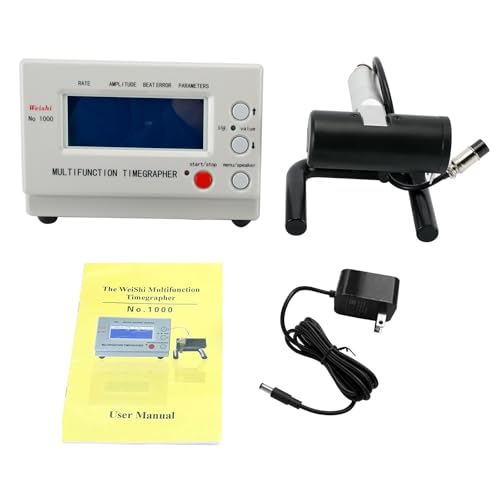
- Measures rate, amplitude, and beat error
- Six positions and selectable sampling periods
- 3-inch LCD with visual ticking display
Best For: Mechanical-watch collectors seeking adjustable testing
Complete Kit
Mechanical Watch Calibrator with Pickup

- Measures rate, amplitude, and beat error
- Automatic or manual beat selection
- Includes pickup, adapter, and manual
Best For: Bench-based hobbyists wanting a ready-to-use kit
Compact Classic
NO.1000 Multifunction Timegrapher

- Works with almost all mechanical watches
- Supports coaxial testing
- Compact corded-electric design
Best For: Collectors wanting a simple compact tester
Enhanced Display

- Shows five timing-related readings
- Larger screen than the No.1000
- Works with coaxial watches and includes one-year warranty
Best For: Collectors wanting detailed live measurements
Compact Pocket-Watch Tester
Ewatchparts Multifunction Timegrapher

- Listed for compatible pocket watches
- Multifunction timegrapher design
- Verify model and size before ordering
Best For: Hobbyists testing compatible pocket watches
Large-Screen Coaxial Tester

- Larger LCD than the No.1000
- Works with mechanical and coaxial watches
- 100V–240V corded power support
Best For: Collectors testing mechanical and coaxial watches
Precision Diagnostic Bench Tool

- ±0.1 seconds-per-day stated accuracy
- Displays rate, amplitude, beat error, and curves
- Supports six positions for mechanical watches
Best For: Enthusiasts performing detailed mechanical-watch diagnostics
Flexible Data Tracking

- Measures rate deviation, amplitude, and beat error
- Sampling periods range from 2 to 60 seconds
- LCD displays a frequency diagram
Best For: Hobbyists wanting adjustable sampling and detailed on-screen readings
Easy Everyday Testing
No.1000 Mechanical Watch Timegrapher
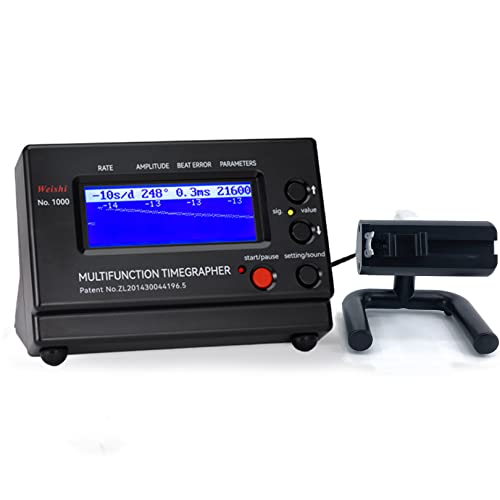
- Shows five key timing readings on its LCD
- Designed for easy out-of-box operation
- Supports most mechanical and coaxial watches
Best For: Collectors and hobbyists wanting simple, broad-compatibility testing
Beginner-Friendly Accuracy Checks

- Measures beat rate, beat error, amplitude, and rate deviation
- Displays results numerically and graphically
- Includes sensor, US adapter, manual, and cleaning cloth
Best For: Novice watchmakers learning mechanical-watch timing analysis
Value Pick – YaeTek NO.1000 Timegrapher
For hobbyists comparing watch timing machines, the YaeTek NO.1000 offers automatic readings for rate, amplitude, and beat error on mechanical watches. Its LCD screen provides live results, while selectable sampling periods and six testing positions support more flexible checks.
Best For: Mechanical-watch collectors who want adjustable testing and clear on-screen readings.
Pros:
- Automatically calculates rate, amplitude, and beat error.
- Supports six testing positions and sampling periods from 2 to 60 seconds.
- LCD includes moving dotted lines for a visual representation of the watch’s ticking.
- Designed for 110V–220V power with a US plug.
Cons:
- The listed rate deviation range is broad at ±999 seconds per day.
- Its 3-inch screen is smaller than some newer timegraphers.
Automatic signal adjustment and multiple sampling options make this a practical entry point for hobbyists who want more than a basic timing display.
Complete Kit – Mechanical Watch Calibrator with Pickup
This mechanical watch timing machine is a workbench-oriented option for hobbyists who want a supplied pickup and dedicated controls. It measures rate deviation, amplitude, and beat error, with automatic adjustment, manual or automatic beat selection, selectable intervals, and multiple test positions.
Best For: Hobbyists who prefer a ready-to-start bench setup with a separate pickup and instruction manual.
Pros:
- Analyzes rate deviation, amplitude, and beat error.
- Offers automatic adjustment plus automatic and manual beat selection.
- Supports selectable test intervals and multiple testing positions.
- Includes the main housing, separate pickup, power adapter, and manual.
Cons:
- The supplied notes do not specify screen size or measurement precision.
- Its workbench form may be less convenient for users seeking a highly portable tool.
With its separate pickup and broad adjustment features, this model emphasizes setup flexibility and straightforward bench analysis rather than extra display detail.
Compact Classic – NO.1000 Multifunction Timegrapher
Among watch timing machines for hobbyists, this compact NO.1000 is a straightforward corded-electric tester for almost all mechanical watches. Its multifunction design is positioned for both watch collectors and professional watchmakers, with coaxial testing support noted in the product description.
Best For: Collectors who want a compact, corded tester for mechanical-watch timing checks.
Pros:
- Designed for almost all mechanical watches.
- Supports coaxial testing.
- Compact dimensions of approximately 6.77 × 1.57 × 4.49 inches.
- Uses a corded-electric power source.
Cons:
- The supplied notes do not list readings for amplitude or beat error.
- No sampling-period or testing-position options are specified.
This is a focused choice when compact size and broad mechanical-watch compatibility matter more than a detailed list of advanced controls.
Enhanced Display – No.1900 LCD Timegrapher
The No.1900 is a watch timing machine for hobbyists who want live information on a larger screen. It displays rate, amplitude, beat error, beat, and lift angle, and is described as more precise and larger-screened than the No.1000. It also works with almost all mechanical watches, including coaxial watches.
Best For: Collectors who want a broad set of live measurements and an easier-to-read display.
Pros:
- Displays rate, amplitude, beat error, beat, and lift angle.
- Features a larger screen than the No.1000.
- Works with almost all mechanical watches, including coaxial watches.
- Includes a one-year warranty and customer service support.
Cons:
- The supplied notes do not provide exact measurement precision.
- It uses AC power, which may limit placement away from an outlet.
Its expanded readout and larger LCD make the No.1900 a strong upgrade for hobbyists who want more timing information visible at once.
Compact Pocket-Watch Tester – Ewatchparts Multifunction Timegrapher
Ewatchparts Watch Timing Machine Multifunction Timegrapher 1000 Compatible With Pocket Watch
Check Price On AmazonFor shoppers comparing watch timing machines for hobbyists, this Ewatchparts multifunction timegrapher is specifically listed as compatible with pocket watches. Confirm your watch model and measure the relevant size before buying, since compatibility is model- and size-specific.
Best For: Hobbyists testing compatible pocket watches who want a compact, aftermarket timing-machine option.
Pros:
- Designed for pocket-watch compatibility.
- Listed as a multifunction timegrapher.
- Compact 2-inch listed item length.
Cons:
- Compatibility should be verified carefully before purchase.
- The supplied details do not specify measurement accuracy, display type, or power source.
This is a focused option for pocket-watch owners, but the limited specifications make pre-purchase compatibility checking especially important.
Large-Screen Coaxial Tester – MTG No.1900 Timegrapher
OTOOLWORLD New Coaxial MTG Watch Tester Timing Multifunction Timegrapher LCD Screen NO.1900
Check Price On AmazonThe MTG No.1900 is a practical choice among watch timing machines for hobbyists who work with mechanical watches, including coaxial models. Its larger LCD screen is intended to make readings easier to view and operation more straightforward.
Best For: Mechanical-watch collectors and hobbyist watchmakers who want a larger display and coaxial-watch compatibility.
Pros:
- Larger LCD screen than the No.1000 model.
- Compatible with almost all mechanical watches and designed to work better with coaxial watches.
- Supports 100V–240V power and includes exchangeable regional mini plugs.
Cons:
- It is a corded-electric instrument rather than a battery-powered tester.
- The supplied details do not provide accuracy or measurement-range specifications.
Its clear selling point is usability: the larger screen and broad mechanical-watch compatibility make it appealing for a home bench, especially when coaxial movements are part of the collection.
Precision Diagnostic Bench Tool – SWANSOFT No.1000 Timegrapher
For serious watch timing machines for hobbyists, the SWANSOFT No.1000 offers detailed diagnostics for mechanical movements. It displays rate, amplitude, beat error, lift angle, and timing curves, while supporting six positions and adjustable sampling settings.
Best For: Enthusiast collectors and watchmakers diagnosing and calibrating mechanical or automatic movements.
Pros:
- Specified accuracy of ±0.1 seconds per day using a 50-sample average, with a ±999 seconds-per-day range.
- Measures rate, amplitude, beat error, lift angle, and timing curves on a color LCD.
- Supports six positions, 2–60-second sampling cycles, and a 12-month satisfaction guarantee.
Cons:
- Only suitable for mechanical movements; it does not support quartz watches.
- Its extensive diagnostic features may be more than casual users need.
This is the most specification-rich option in the group for mechanical-watch analysis, particularly if you want live graphs and multiple performance metrics rather than a basic timing check.
Flexible Data Tracking – LANRU No.1000 Timegrapher
For hobbyists comparing watch timing machines, the LANRU No.1000 stands out for its adjustable sampling periods and real-time display. It measures rate deviation, amplitude, beat error, and beat, while its automatic signal adjustment helps accommodate different mechanical watches.
Best For: Hobbyists who want flexible sampling options and graphical timing data.
Pros:
- Displays rate deviation, amplitude, beat error, and related data in real time.
- Offers sampling periods from 2 to 60 seconds, plus corresponding average values.
- Shows the watch’s frequency diagram on the LCD screen.
- Automatically adjusts the optimal signal level for different watches.
Cons:
- Manual selection may be needed for special beat configurations.
- Its listed 3.28-pound weight may be more than some casual users need.
The LANRU is a practical choice when you want more control over measurement duration and an on-screen frequency view. Its broad sampling range makes it useful for hobbyists who prefer to examine readings beyond a single quick test.
Easy Everyday Testing – No.1000 Mechanical Watch Timegrapher
KINSANINC Watch Tester Timegrapher No.1000, Watch Timing Machine Calabration for Mechanical Watches
Check Price On AmazonAmong watch timing machines for hobbyists, this No.1000 model focuses on straightforward operation and clear live readings. Its LCD shows rate, amplitude, beat error, beat, and lift angle, while automatic signal-level adjustment supports testing across many mechanical watches, including coaxial models.
Best For: Collectors and hobbyists seeking an easy-to-use timegrapher with broad mechanical-watch compatibility.
Pros:
- Displays rate, amplitude, beat error, beat, and lift angle on the LCD.
- Designed to be easy to use right out of the box.
- Works with almost all mechanical watches and can test coaxial watches.
- Includes automatic optimal signal-level adjustment and a one-year warranty.
Cons:
- Uses corded electric power, so it is not intended for cordless operation.
- The supplied notes do not specify adjustable sampling periods or graphical display features.
This model is a sensible pick for users who prioritize accessible controls and the core measurements needed to evaluate mechanical-watch timing. Automatic signal adjustment and the included warranty add convenience for regular hobby use.
Beginner-Friendly Accuracy Checks – TICFROG No.1000 Timegrapher
The TICFROG No.1000 is a beginner-oriented option among watch timing machines for hobbyists. It measures beat rate, beat error, amplitude, and gain or loss, presenting results numerically and graphically so users can assess a mechanical watch’s timekeeping behavior.
Best For: Novice watchmakers who want essential timing measurements with included setup accessories.
Pros:
- Measures beat rate, beat error, amplitude, and rate gain or loss.
- Presents timing results in both graphical and numerical formats.
- Includes a timegrapher sensor, US adapter, user manual, and cleaning cloth.
- Offers automatic signal-level adjustment and an 18-month satisfaction guarantee.
Cons:
- The manual should be consulted for proper use and any advanced functions.
- It is listed as not water resistant, so it requires protection from moisture.
With its essential measurements, dual display formats, and included accessories, the TICFROG is well suited to learning the basics of mechanical-watch regulation and diagnosis. It offers useful functionality without being positioned as an overly complex instrument.
How We Picked These Watch Timing Machines for Hobbyists
We focused on multifunction timegraphers intended for mechanical-watch testing, regulation, and basic diagnosis. The selected models represent the common No.1000 and No.1900 formats, along with machines marketed for hobbyists, repairers, watchmakers, and pocket-watch users. We considered the information each unit is designed to display, the practical value of its pickup and testing functions, screen readability, stated compatibility, and how suitable the format is for occasional home use.
Because specifications and included accessories can vary by seller, confirm the current listing before buying—particularly supported beat rates, power requirements, pickup design, and whether a suitable holder or cable is included.
Quick Comparison
| Type | Best suited to | What to check |
|---|---|---|
| No.1000-style timegrapher | General hobbyist regulation | Displayed measurements, beat-rate options, controls |
| No.1900-style timegrapher | Users wanting a larger or more feature-focused display | Screen layout, measurement modes, included pickup |
| Pocket-watch-compatible model | Collectors working on larger or differently positioned movements | Holder size, pickup placement, supported formats |
| Professional or repair-oriented model | Frequent testing and repeated adjustments | Durability, repeatability, warranty, documentation |
Key Buying Factors for Watch Timing Machines for Hobbyists
Measurements and Beat-Rate Support
At minimum, look for rate, amplitude, beat error, and beat rate. A broad selection of beat-rate settings helps when testing watches with less-common movements. A timegrapher is a diagnostic aid, not a substitute for proper servicing, but clear readings make regulation decisions more informed.
Pickup and Watch Compatibility
The pickup must hear the movement consistently without holding the case awkwardly. Check whether the machine is designed for wristwatches, pocket watches, or both. A stable holder and adjustable positioning can matter more than extra menu features.
Display and Controls
Readable LCD output, straightforward buttons, and an uncluttered trace are valuable when you are making small adjustments. If you work at a bench, prioritize visibility from your normal seating position and controls that do not require constant reference to a manual.
Power, Build, and Included Accessories
Verify whether the unit uses an adapter, USB power, or another arrangement, and confirm that the correct power supply is included. Compare the supplied pickup, holder, and cables rather than assuming similarly named models have identical bundles.
Who Should Buy Which Watch Timing Machines for Hobbyists?
Choose a straightforward No.1000-style tester if you mainly regulate common mechanical wristwatches and want essential readings without an elaborate setup. Consider a No.1900-style model if display presentation, additional testing modes, or a more feature-rich interface is important to you. Pocket-watch owners should prioritize the model with the clearest compatibility statement and the most practical holder arrangement. If you repair watches frequently, spend more attention on repeatable pickup performance, construction, support, and warranty than on the lowest purchase price.